
In many classrooms across Pakistan, teachers work extremely hard to prepare lessons, activities, and assessments. Yet one common classroom problem quietly reduces learning outcomes: unclear instructions. When instructions are confusing, even the most creative lesson plans fail to produce meaningful learning.
From a psychological perspective, learning does not begin when a teacher explains a concept; it begins when a student clearly understands what he or she is expected to do. This makes the skill of giving clear instructions one of the most important — yet most ignored — competencies in teacher training.
Why Clear Instructions Matter More in Pakistan
Pakistani classrooms often include:
- Large student numbers
- Mixed-ability learners
- Students learning in a second or third language
- Limited instructional time
- Pressure to complete syllabus quickly
In such environments, long and complicated explanations overload students’ working memory, causing confusion, anxiety, and disengagement. When students are unsure what to do, they either remain silent, copy others without understanding, or lose interest altogether. This is not a student motivation problem; it is often an instruction clarity problem.
The Psychological Principle: Cognitive Load
Educational psychology explains that the human brain can process only a limited amount of information at one time. When teachers give long verbal instructions, students spend mental energy decoding the instruction instead of performing the learning task. Clear, short, step-by-step instructions reduce cognitive load and improve performance instantly.
This is why the golden rule for teachers should always be:
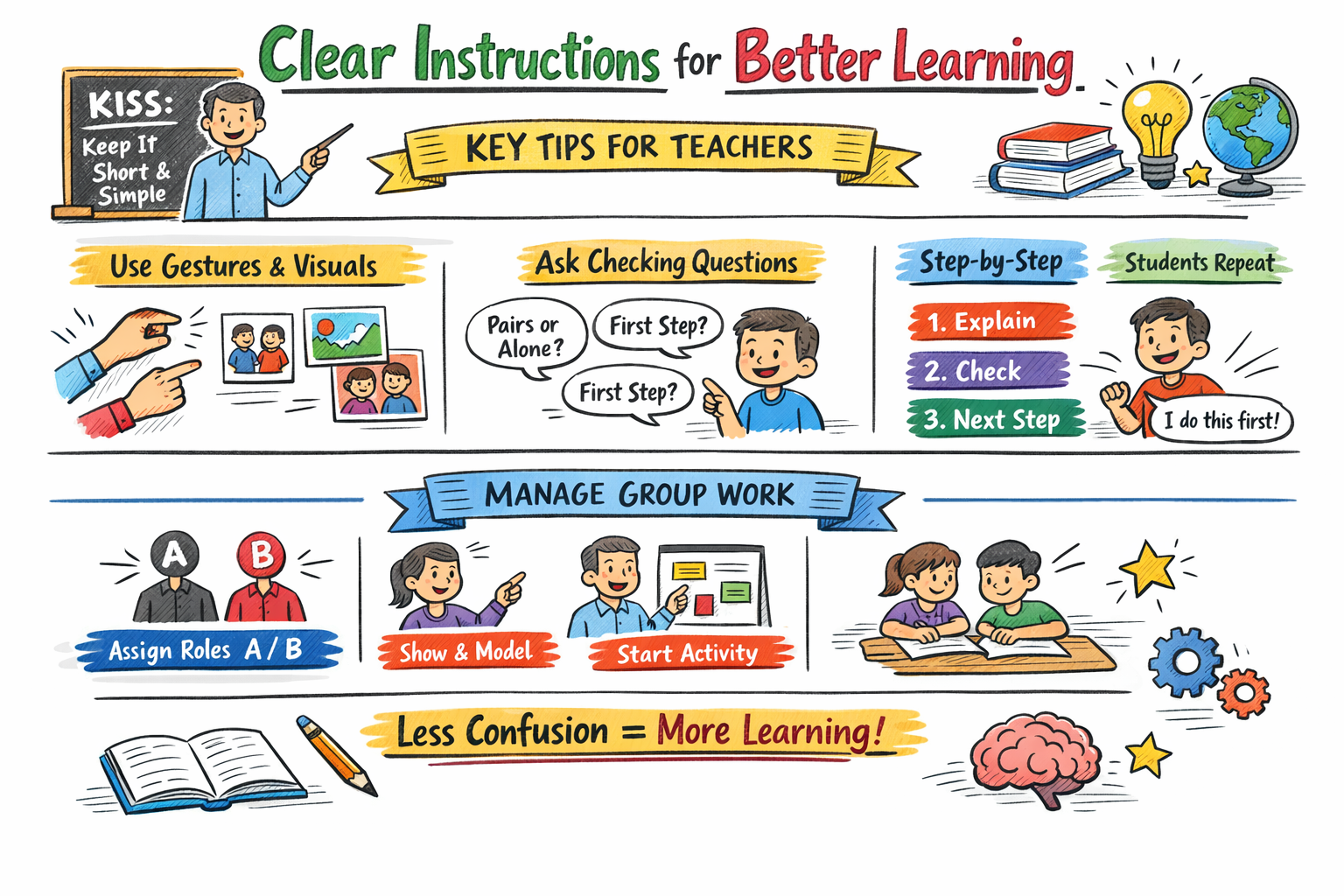
KISS — Keep It Short and Simple.
Practical Instruction Techniques Every Teacher Should Apply
1. Use Gestures, Demonstrations, and Visuals
Students understand faster when instructions are shown, not only spoken. Simple gestures such as pointing, demonstrating a sample answer, or using pictures can reduce explanation time by half. Over time, consistent gestures create classroom routines, increasing discipline without shouting.
2. Replace “Do You Understand?” with Checking Questions
In Pakistani classrooms, students often say “Yes, teacher” out of respect, even when confused. Instead, teachers should ask task-focused checking questions:
- “Will you work alone or in pairs?”
- “What will you write first?”
- “How many sentences will you write?”
These questions confirm actual understanding.
3. Give Instructions Step-by-Step
Avoid giving all instructions at once. Instead:
- Explain the first step
- Check understanding
- Demonstrate if needed
- Then move to the next step
This structured sequencing significantly reduces classroom chaos.
4. Ask Students to Repeat Instructions
When students repeat instructions in their own words (English or local language), teachers can immediately identify misunderstandings and correct them early.
Managing Pair and Group Work Effectively
Group activities fail not because students are weak, but because roles are unclear. Teachers should always follow a clear order:
- Assign roles (Student A / Student B)
- Ensure everyone knows their role
- Show the task visually
- Model the expected language or answer
- Begin the activity
A 30-second demonstration often saves 10 minutes of confusion.
Institutional Importance: A System-Level Need
In many Pakistani schools, teacher evaluation focuses heavily on syllabus completion rather than instructional clarity and classroom communication skills. School leadership and training departments must recognize that improving instruction delivery skills can immediately improve learning outcomes without additional resources.
Schools should also develop standard classroom gestures and instruction routines across all classes. Consistency builds student confidence, reduces anxiety, and improves behavioral control.
Final Reflection
Teaching is not only about subject knowledge; it is about how learning is guided. Clear instructions create:
- smoother classroom flow
- higher participation
- reduced behavioral issues
- stronger student confidence
- better academic results
Sometimes the most powerful teaching improvement is not adding more content, but simplifying communication.
In education, especially in developing learning environments like Pakistan, one principle always holds true:
Less confusion means more learning. Clear instructions are not a small skill — they are the foundation of effective teaching.

Related Posts